

How to Write Protect a File on Windows
Write protection is appropriate when people may open a reference file but should not change it. Unlike locking, it is intended to preserve readable access; unlike encryption, it does not conceal the contents.
Quick answer
Start File Lock Pro and select the workspace used to prevent changes. Back up the target first, apply the narrowest useful rule, and test both authorized access and the action that should be blocked.
Choose Write Protection or Another Control
| Situation | Recommended approach | Check carefully |
|---|---|---|
| Allow reading but stop changes | Protect the selected file | Applications that save beside the file |
| Require a password before opening | Lock the file | Recovery and authorized access |
| Protect confidentiality outside this PC | Encrypt the file | Key storage and recipient workflow |
| Recover from corruption or ransomware | Keep versioned backups | Access control alone is not recovery |
Step-by-Step Workflow
- Back up and close the file
Keep a verified copy outside the protected path and close every application using the file.
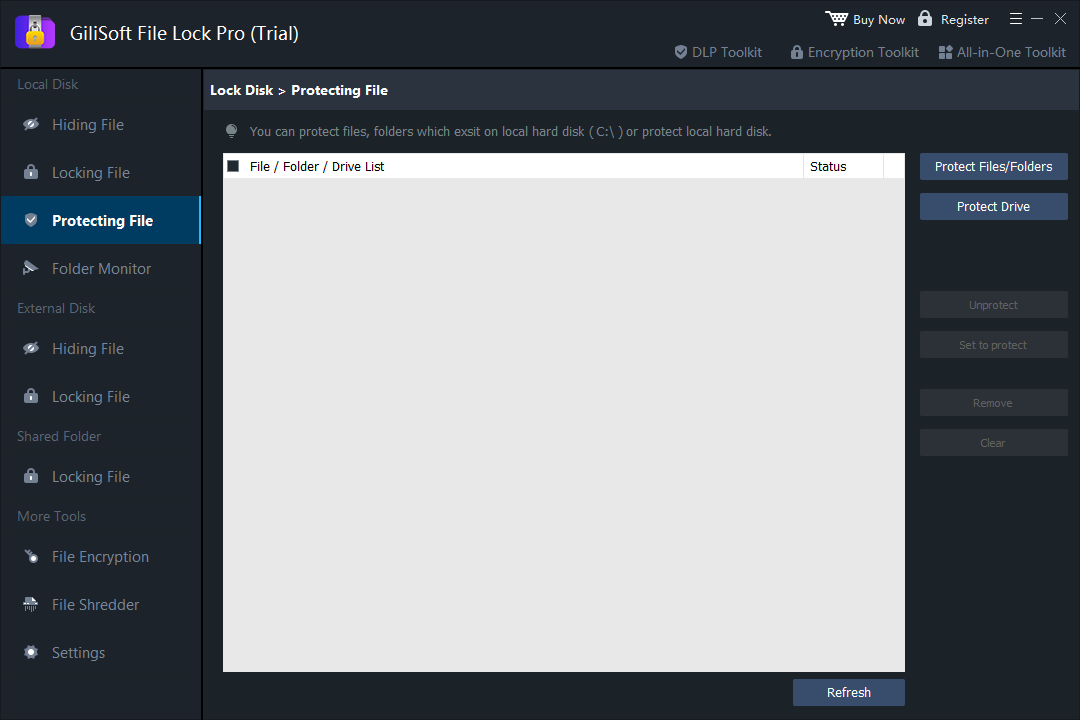
- Open Local Disk and Protecting File
Start File Lock Pro and select the workspace used to prevent changes.
- Add the exact file
Choose Protect Files/Folders and confirm the filename and full path.
- Apply protection and test operations
Try opening, editing, saving, renaming, moving, overwriting, and deleting from the real user and application context.
- Restore write access when approved
Remove the rule through File Lock Pro, make the authorized update, and reapply only if the requirement remains.
See the File Lock Pro user guide for every workspace, password recovery, and related protection task.
GiliSoft File Lock Pro Interface
These product screenshots connect the workflow to the relevant local Windows controls.

Review the Protection Boundary
- Keep a verified backup before applying broad access or write restrictions.
- Use a standard user account to test both the permitted workflow and the blocked action.
- Protect the administration password and document how authorized recovery works.
- Keep Windows Security enabled and use encryption when offline data exposure is in scope.
Frequently Asked Questions
Is write protection the same as read-only?
They share the goal of allowing reading while blocking changes, but product and Windows attribute behavior can differ. Test the actual file.
Can users copy the file?
A write restriction may still allow reading and copying. Use locking or encryption if copying and access must be controlled.
Why can the application not save changes?
That is expected when writes are blocked. Remove the rule temporarily or work on an authorized copy.
Will this stop ransomware?
It is not a complete ransomware defense. Keep endpoint protection and versioned backups enabled.