Add Images or a Folder
Load JPG, PNG, WebP, HEIC, RAW, TIFF, BMP, GIF, and other supported source files into the batch.

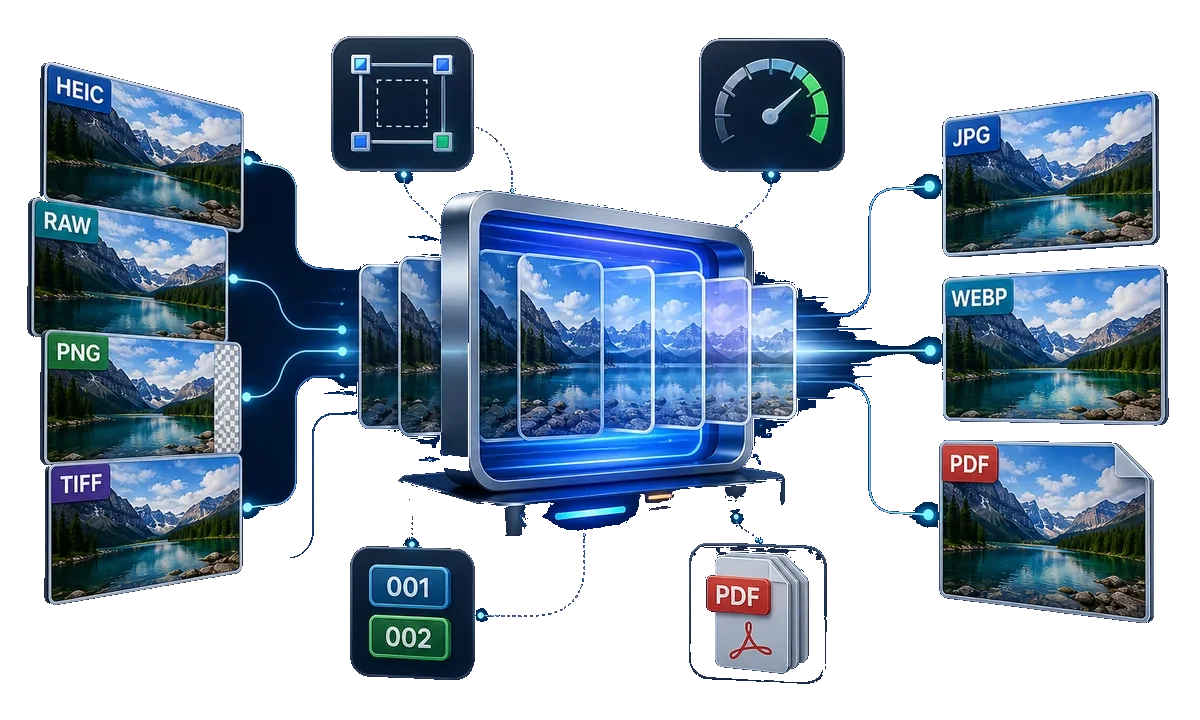
GiliSoft Image Converter is a Windows desktop tool for turning mixed image sources into formats that websites, documents, design applications, customers, and shared systems can use. It supports everyday formats such as JPG, PNG, BMP, GIF, WebP, and TIFF together with HEIC and RAW sources.
The same batch can also be resized, rotated, renamed, compressed, and organized before delivery. Image-to-PDF, split, merge, editing, beauty, repair, and recovery utilities are available when a folder needs more than a format change.

Convert supported images between JPG, PNG, BMP, GIF, WebP, TIFF, and other practical output formats, one file or a complete batch at a time.
Prepare phone and camera files as more widely usable images for review, upload, design handoff, sharing, or archive delivery.
Apply consistent dimensions, framing, orientation, and naming rules across larger image folders before they leave your Windows PC.
Reduce file size for websites, email, documents, or storage while checking that the selected quality remains suitable for its destination.
Package scans, screenshots, proofs, and reference images as PDF output for review, printing, documentation, or archive delivery.
Divide large images, combine files horizontally, vertically, or in a grid, and organize output using practical file properties.

Batch conversion saved us manual time when processing product image folders.
HEIC to JPG conversion is stable, and upload compatibility issues are much easier to avoid.
RAW conversion quality is reliable for moving camera files into our design process.
Compression settings helped us reduce web image size while keeping visual quality acceptable.
Inspect the real GiliSoft Image Converter workspace for format conversion, resizing, renaming, image-to-PDF output, and the additional repair toolbox.
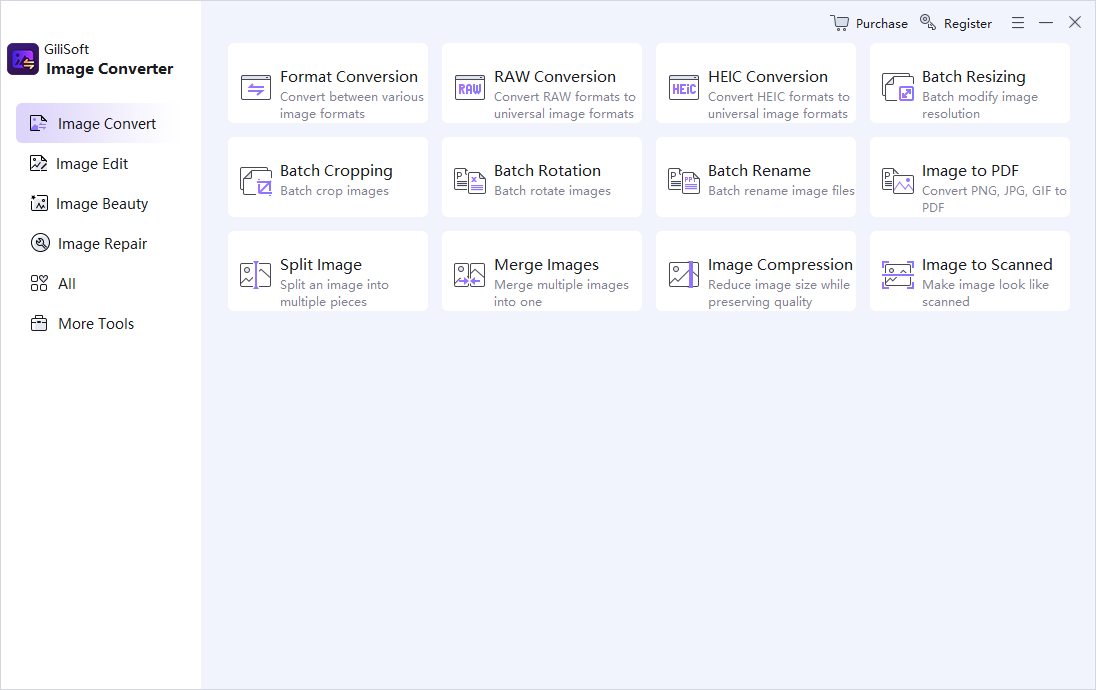
Start from the main Image Converter workspace, then choose conversion, batch processing, PDF output, or toolbox utilities.
Prepare a complete folder with one repeatable set of output rules.
Load JPG, PNG, WebP, HEIC, RAW, TIFF, BMP, GIF, and other supported source files into the batch.
Select the target format, dimensions, orientation, compression, file naming, and output location required by the next workflow.
Process the selected files locally, then open representative results to confirm quality, transparency, dimensions, and naming.
Download the Windows trial and process representative HEIC, RAW, JPG, PNG, WebP, or TIFF files with the same batch settings.
Standardize format, dimensions, orientation, file names, and file size before uploading a catalog to a marketplace or store CMS.
Turn HEIC and supported RAW files into JPG, PNG, or another format that customers, colleagues, or downstream software can open.
Create lighter delivery copies for article images, support screenshots, campaign assets, and documentation while retaining the original files.
Combine ordered scans, screenshots, visual records, or review proofs into PDF output that is easier to print and send.
Open the included editor when a converted file needs a practical adjustment before final output.
Apply light cleanup to people-focused images without presenting the converter as a complete portrait retouching studio.
Use separate repair tools for old-photo restoration, colorization, and supported corrupted-image repair tasks.
Open the recovery utility when images were deleted or lost. Recovery is a separate task from converting healthy source files.
Yes. Add multiple files or a folder, select the output format and batch settings, then process the selected sources together.
Choose according to the destination: JPG for broadly compatible photos, PNG for transparency or lossless graphics, and WebP for supported web workflows that prioritize smaller files.
Yes. Use the batch tools to apply consistent dimensions, crop, rotation, compression, and file-name rules before delivery.
Yes. Write converted files to a separate output folder and inspect representative results before replacing, moving, or archiving the originals.
Open the GiliSoft Image Converter User Guide for format conversion, HEIC and RAW files, batch resizing and renaming, Image to PDF, editing, repair, recovery, and output checks.

Prepare phone photos, camera sources, graphics, screenshots, and existing web assets without converting every file in a separate utility.

Apply the same format, dimensions, orientation, quality, and naming pattern to reduce manual differences between delivered files.

Convert and prepare supported files on the Windows PC instead of uploading routine customer, product, or internal images to an online converter.


Enter your email address to get our latest newsletter