No absolute protection from a camera
Software may deter screenshots and common capture paths, but it cannot prevent someone from filming a monitor with another device.

Choose password-protected GFX or EXE packages for straightforward local sharing, or use DRM controls when viewer access must remain manageable after the video has been delivered.
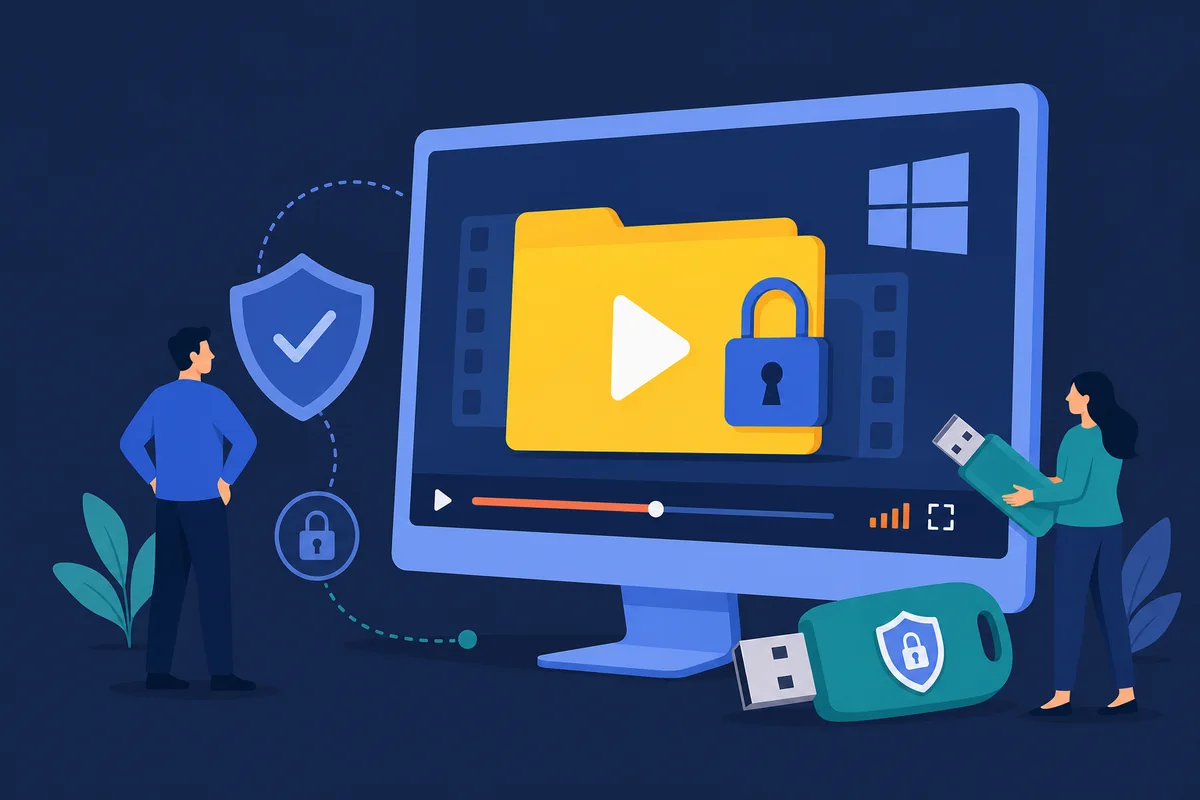
The two approaches overlap because DRM also uses encryption. The practical difference is what happens after the protected video leaves your computer. A simple encrypted package mainly asks, “Does this viewer know the password?” A DRM workflow can also ask, “Is this the approved device, is this credential still allowed, and should identifying information appear during playback?”
Best for private previews, internal videos, classroom files, demos, and straightforward offline delivery to known recipients.
Best for paid training, membership content, reseller previews, licensed media, and delivery where access must remain controllable.
Video encryption transforms an ordinary media file into protected output that cannot be opened as a normal MP4, AVI, WMV, or other source file. GiliSoft Any Video Encryptor creates GFX or Windows EXE packages, applies a playback password, and uses a protected viewing process instead of handing the recipient the original open video.
Video DRM combines encryption with playback policies. GiliSoft Video DRM Protection can create protected GEM or EXE output and add PC, USB disk, or CD/DVD binding, fixed or dynamic watermarks, anti-copy settings, and an online blacklist for passwords that should no longer work.
| Decision point | Any Video Encryptor | Video DRM Protection |
|---|---|---|
| Main goal | Turn videos and related files into password-protected local packages. | Package protected content with viewer, device, and distribution rules. |
| Protected output | GFX or Windows EXE. | GEM or Windows EXE. |
| Basic access check | Playback password. | Playback password plus selected binding and policy options. |
| Offline delivery | Strong fit for local folders, USB drives, external disks, and other offline channels. | Supports controlled package delivery; the chosen blacklist or online password process may add a network-dependent control. |
| Device binding | EXE output can be bound to an authorized USB drive. | PC, USB disk, CD/DVD, demo, and fixed-password modes are available. |
| Watermark traceability | Not the primary workflow. | Fixed or dynamic watermarking can display viewer or delivery information. |
| Revoke a leaked password | Replace the package or password and redistribute it. | Add leaked, expired, or withdrawn passwords to the online blacklist. |
| Capture and Save As deterrence | Protected viewing can deter screenshots and ordinary Save As access. | Anti-copy and anti-capture controls can be combined with DRM playback rules. |
| Best audience | Individuals, small teams, teachers, and businesses sharing with known recipients. | Course sellers, training teams, publishers, compliance teams, and licensed-content distributors. |
| Setup complexity | Simpler: add files, choose output, set a password, and export. | More policy decisions: choose password creation, binding, watermark, blacklist, and output settings. |
EXE output is convenient for Windows delivery but has a 4 GB package limit. Use GFX for larger protected output or when the dedicated encrypted-player route is more appropriate.
DRM is the better fit when access is not a one-time packaging decision. Microsoft’s PlayReady documentation describes the general DRM principle clearly: encrypted content is paired with rights and restrictions that a capable client must enforce. GiliSoft provides its own desktop-oriented implementation of that broader controlled-playback idea.
Choose encryption. A password-protected GFX package is usually enough when one known client needs offline review.
Choose DRM. Device rules, viewer watermarks, and password revocation are more valuable when access is sold to many learners.
Choose based on control. Use USB-bound EXE encryption for simple drive-tied delivery; use DRM when you also need traceability or revocation.
Choose encryption. Password packaging is efficient when recipients and delivery channels are already trusted.
Choose DRM. Watermarks and separate credentials help distinguish copies sent to different partners.
Choose encryption. GFX or EXE delivery avoids dependence on a streaming platform when a shared password is acceptable.
Software may deter screenshots and common capture paths, but it cannot prevent someone from filming a monitor with another device.
If an unprotected source file has already leaked, encrypting a new copy does not recover or revoke the old open file.
Strong protection still depends on controlled passwords, approved recipients, verified devices, and secure handling of source files.
Protected GFX, GEM, and EXE output is intended for the corresponding GiliSoft playback workflow rather than ordinary media players.
No. Encryption is one component of DRM. DRM adds rights or policies that determine how an authorized client may use the encrypted content.
Usually not. If a local password-protected package is enough, Any Video Encryptor is the simpler choice.
Yes. GFX and EXE packages are designed for local password-based playback. The recipient uses the protected package rather than an ordinary video file.
Simple password encryption does not provide the same blacklist workflow. Choose Video DRM Protection when leaked or withdrawn passwords may need to be blocked after delivery.
Use Any Video Encryptor for a straightforward USB-bound EXE package. Use Video DRM Protection when USB delivery also needs watermarks, additional binding choices, or blacklist control.
Video DRM Protection is generally the better fit because paid training often needs separate viewer credentials, device rules, traceability, and a way to respond to leaked access.
These references explain the general distinction between cryptographic confidentiality and DRM licensing. They do not imply that GiliSoft products implement the referenced commercial DRM systems.
Start with password-protected video encryption for simple local sharing. Choose Video DRM Protection when access, devices, watermarks, or leaked credentials must remain manageable after delivery.