

DVD to AVI Converter for Windows
Converting a DVD to AVI is useful when an older player, editing application, media library, or hardware device specifically requires the AVI container. Compatibility depends on the video and audio codecs inside the AVI file, not only its extension.
Quick answer
In GiliSoft Home DVD Converter, load a home DVD disc, ISO image, or VIDEO_TS folder; identify the correct title; choose an AVI profile supported by your player or editor; then select the audio and subtitle tracks. Convert a short sample and check it before processing the full title. Use MP4 when the destination does not specifically require AVI.
AVI Is a Container, Not a Single Codec
An AVI file can contain different video and audio streams. Two files ending in .avi may behave differently because one player supports the codec inside the first file but not the second. Check the destination requirements before choosing a profile.
| Destination | What to check | Practical guidance |
|---|---|---|
| Legacy DVD/USB player | Exact AVI and codec support in the manual | Use the listed profile and keep resolution within the device limit. |
| Older Windows software | Supported decoder, frame size, and audio format | Test a short clip before converting a full movie or event recording. |
| Video editor | Import codec and preferred frame rate | Choose a less compressed editing profile when the software supports it and storage allows. |
| General modern playback | Whether AVI is actually required | MP4 is often easier to play across current phones, TVs, browsers, and computers. |
Choose AVI Settings That Match the Destination
| Setting | Recommended approach | Common problem |
|---|---|---|
| Video codec | Choose an available AVI profile explicitly supported by the destination. | Unsupported codec causes a black screen, error, or video without picture. |
| Resolution | Keep the DVD source dimensions or use a tested destination preset. | Unnecessary upscaling increases file size without restoring detail. |
| Aspect ratio | Preserve 16:9 or 4:3 display geometry from the source. | Wrong settings stretch faces or add avoidable cropping. |
| Frame rate | Keep the source rate unless the target requires a specific value. | Arbitrary conversion can create judder or duplicate frames. |
| Video bitrate | Balance visible quality with the required file size. | Too low creates blockiness; excessive bitrate only makes a larger file. |
| Audio | Select the intended DVD track and a codec supported by the target player. | An unsupported audio stream can produce video with no sound. |
| Subtitles | Choose the required subtitle track and verify how it appears in the output. | The default track may be the wrong language or may not be included. |
How to Convert a DVD to AVI with GiliSoft
- Load the home DVD source
Open GiliSoft Home DVD Converter and load a readable disc, ISO image, or complete VIDEO_TS folder.
- Select the correct title
Compare durations and preview likely titles. Do not assume the longest entry is always the main program.
- Choose an AVI output profile
Select AVI and choose the available profile that matches the receiving player, editor, or device.
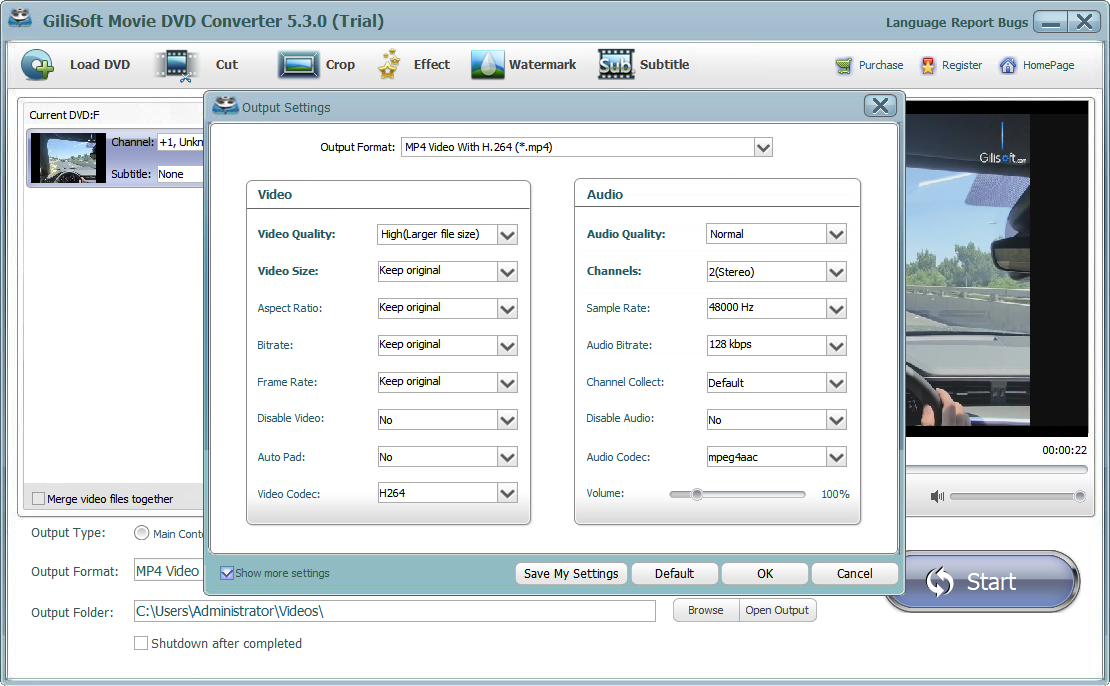
- Set picture, audio, and subtitle options
Confirm resolution, aspect ratio, bitrate, frame rate, audio language, channels, and subtitle behavior.
- Convert a representative sample
Test a section containing motion, speech, music, and subtitles, then check playback in the actual destination.
- Convert and verify the complete title
Review the beginning, middle, and end for picture quality, audio sync, subtitle timing, and seeking.
The screenshots below show an earlier version of the interface; labels may differ in the current release.

Balance AVI Quality and File Size
DVD-Video is standard definition. Increasing the output resolution cannot recreate detail that is not present in the source. File size is mainly affected by duration, resolution, video bitrate, codec efficiency, and audio settings.
- Keep the source aspect ratio to avoid stretched or squeezed video.
- Use a moderate bitrate test before selecting a much larger file.
- Avoid repeated conversion because each lossy encode can reduce quality.
- Deinterlace only when interlacing lines are visible on progressive displays.
- Keep the original DVD or ISO until the completed AVI has been fully verified.
Troubleshoot DVD to AVI Conversion
| Problem | Likely cause | What to try |
|---|---|---|
| AVI has no picture | The player does not support the selected video codec. | Choose a compatible AVI profile or install/use a player that supports the codec. |
| AVI has no sound | Wrong DVD track or unsupported audio codec. | Select the intended audio track and test a different compatible audio setting. |
| Picture is stretched | Incorrect aspect ratio or output dimensions. | Preserve the source display ratio and retest a short section. |
| File is too large | High bitrate, inefficient profile, or uncompressed audio. | Reduce bitrate carefully or choose a more efficient destination format. |
| Audio drifts out of sync | Frame-rate conversion or source timing issue. | Keep the source frame rate and test another AVI profile. |
| Wrong title or language | Incorrect title, audio track, or subtitle selection. | Preview the source and choose tracks before full conversion. |
DVD to AVI Converter FAQ
Is AVI a video codec?
No. AVI is a container that can hold different video and audio codecs. The destination must support both the AVI container and the streams inside it.
Which AVI codec should I choose?
Choose the AVI profile explicitly supported by the target player or editor. Legacy devices may expect MPEG-4 Part 2 variants, while editing workflows may prefer a less compressed profile when available.
Why is the AVI file so large?
File size depends on duration, resolution, video bitrate, codec efficiency, and audio settings. Lowering bitrate reduces size but can reduce quality.
Why does the AVI file have no sound?
The player may not support the selected audio codec, or the wrong DVD audio track may have been chosen. Test another compatible audio profile and verify the intended track before full conversion.
Can I convert a DVD ISO or VIDEO_TS folder to AVI?
Yes. GiliSoft Home DVD Converter can load supported physical DVDs, ISO images, and VIDEO_TS folders for authorized conversion.
Should I use AVI or MP4?
Use AVI when a legacy player, editor, or device specifically requires it. For general modern playback, MP4 with a widely supported codec is usually the first format to test.